







Children learn to speak by hearing speech — not swiping. But the right tech, used wisely, can support language, not silence it.
A child’s brain is wired for words.
From birth, they’re tuning into the rhythm, tone and melody of language. And by the time they reach Reception, their vocabulary size is one of the strongest predictors of school success.
But in today’s screen-saturated world, many children are hearing fewer words and speaking less.
📉 One UK study found that toddlers heard 4 million fewer words by age 3 if regularly exposed to heavy screen time.
Because screens can replace conversations — rather than stimulate them.
Technology isn’t the villain. But it needs a purposeful place in a child’s day.
It’s used passively (e.g., background TV, YouTube autoplay)
It replaces live, responsive conversations
It dominates mealtimes, play, car journeys or bedtime routines
It’s interactive and co-viewed with an adult
It encourages turn-taking, naming, predicting and discussing
It builds on a child’s real-world interests
Who is involved, how it’s used, and what happens afterwards.
Language grows in relationships, not isolation.
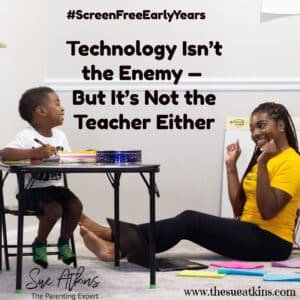
Narrate your day. Let children hear the rhythm of speech:
“I’m chopping carrots. Orange and crunchy. What comes next?”
Children don’t just need talking at them — they need talking with.
Ask:
“What do you see?”
“How do you think they feel?”
“Can you tell me what happens next?”
The tech isn’t the teacher — you are.
Even if no one’s watching, background noise disrupts focus and play — and adults speak less when it’s on.
Keep play and conversation screen-free, especially in shared spaces.
Story apps aren’t a replacement for real books or bedtime stories.
Let children hear stories with:
Intonation
Expression
Pauses for questions
It’s not just reading — it’s a relationship.
Role-play builds narrative structure, vocabulary and creativity.
Whether it’s playing shops, pirates or doctors, children use rich language to bring their ideas to life.
Try:
“I spy something that starts with S”
Sound walks (what can we hear outside?)
“Simon Says” for following instructions
Simple games = powerful listening skills.
Ask open-ended questions:
“What do you notice?”
“Why do you think that happened?”
“How did that make you feel?”
Children absorb language from those who model curiosity.
Children don’t need grammar lessons – they need opportunities to express themselves, be listened to, and gently expanded.
If a child says:
“Me goed to the park.”
You can say:
“Yes, you went to the park! What did you do there?”
Correct through modelling, not criticism.
In settings where school readiness is a hot topic, don’t default to formal learning.
Instead:
Give space for small-group storytimes
Use everyday routines for rich talk (e.g., snacktime, tidy-up)
Train staff in sustained shared thinking — those magical moments when an adult and child share a conversation that deepens thinking and vocabulary
It’s the dialogue, not the device, that grows the brain.
Children don’t need constant chatter or screen bans.
They need language-rich relationships, playful exploration, and moments of wonder.
So whether you’re a parent, practitioner, or both:
Let’s make real-world, real-voice conversation the centrepiece of early years learning.
Because before a child can read and write, they must listen and speak.

✅ Spark conversations
✅ Boost listening and language
✅ Balance tech time with real talk
Perfect for homes, nurseries and classrooms preparing little ones for a big world.
Let’s raise confident communicators — one word at a time.
